[–] jmyeet 3 days ago
Oil wells decrease in production over time. It's called the decline rate. For wells in the Permian basin, the average decline rate is about 15%. So a 1000 barrel per day ("bpd") well produces ~850bpd in year 2, ~700bpd in year 3 and ~550bpd in year 4. That means you need to be constantly drilling wells. That's more wealth concentration opportunity.
1MW of solar produces 1MW in years 1 through 20.
Additionally, the fight for control over resources induces demand for weapons. Solar doesn't do that. This is summed up as No one goes to war over a solar panel [1].
Efficiency isn't the goal. Wealth extraction is.
[1]: https://www.theenergymix.com/no-one-goes-to-war-over-a-solar...
[–] bruce511 3 days ago
I agree with your post, but the above statement is not technically accurate.
Panels do drop in production over time; A very rough rule-of-thumb is around 1% loss per year.
So after 20 years production is at like 80%. (Ymmv)
Of course this isn't really a big deal. The panels themselves are cheap and can be replaced very easily. Equally there is a market for 2nd hand panels as they still produce, and are ideal for places that are not space constrained.
[–] gniv 2 days ago
Only if the oil price remains high. If the world, um, situation stabilizes we will go back to having a glut of oil and hence low prices. Lower than ever I would guess because of the current massive transition to EVs.
[–] vatsachak 3 days ago
[–] HPsquared 3 days ago
[–] jmyeet 3 days ago
Instead we have a captured system where it's cheaper to buy the politics of wealth extraction. Historically speaking this has always led to increasing wealth inequality that is ultimately resolved by war or revolution.
If the ultra-wealthy were smart, they'd declare victory because they've never had it so good and they'd seek to give back a little to placate the populace and stave off that war and revolution. But they don't. Greed has no bounds. So at some points, the guillotines are probably making a comeback. And a lot of people are going to die as climate refugees in the coming decades.
[–] mindwok 2 days ago
It’s also much more effective to grow support across the spectrum then to have an extremely polarised issue where one side gets power and just overpowers the other. Then you get the insane back and forth tug of war when they get in power and just undo everything you did. It’s pointless.
[–] smallerize 3 days ago
[–] api 3 days ago
It goes all the way back to this kind of thing:
https://en.wikipedia.org/wiki/The_Fundamentals
The pamphlet from which we get the term "fundamentalism" was published by an oil industry tycoon.
So the right is incentivized to protect this industry even if it becomes obsolescent and is no longer the most economical or practical way to generate at least much of our energy needs (electricity).
While the right has often sounded pro-nuclear, in practice they tend not to be that enthusiastic about it when they actually get into office. Obama supported the first new nuclear plant in decades.
https://politifact.com/factchecks/2012/mar/02/barack-obama/o...
[–] bryanlarsen 3 days ago
[–] MentalM 2 days ago
I think in that case industries that will became most economical or practical way to generate electricity simply will start funding the right.
[–] nephihaha 3 days ago
The Eastern Bloc in the Cold War was extremely keen on fossil fuels (and nuclear power) and very poor at dealing with pollution. As is the PRC.
In Western Europe, coal miners were the backbone of the far left in places like Germany and the UK including Communist parties. The British Labour Party's vote was traditionally strongest in coal mining areas.
I don't know so much about the US situation, but I am aware that some American coal miners were involved in socialist movements there many decades ago.
[–] api 2 days ago
[–] tzs 3 days ago
Climate change:
> By increasing our American energy supply and decreasing the long term demand for oil, we will be well positioned to address the challenge of climate change and continue our longstanding responsibility for stewardship over the environment.
...
> As part of a global climate change strategy, Republicans support technology-driven, market-based solutions that will decrease emissions, reduce excess greenhouse gasses in the atmosphere, increase energy efficiency, mitigate the impact of climate change where it occurs, and maximize any ancillary benefits climate change might offer for the economy.
...
> Because Republicans believe that solutions to the risk of global climate change will be found in the ingenuity of the American people, we propose a Climate Prize for scientists who solve the challenges of climate change. Honoraria of many millions of dollars would be a small price for technological developments that eliminate our need for gas-powered cars or abate atmospheric carbon.
Clean energy:
> Alternate power sources must enter the mainstream. The technology behind solar energy has improved significantly in recent years, and the commercial development of wind power promises major benefits both in costs and in environmental protection. Republicans support these and other alternative energy sources, including geothermal and hydropower, and anticipate technological developments that will increase their economic viability. We therefore advocate a long-term energy tax credit equally applicable to all renewable power sources.
Reducing demand for fossil fuels:
> Conservation does not mean deprivation; it means efficiency and achieving more with less. Most Americans today endeavor to conserve fossil fuels, whether in their cars or in their home heating, but we can do better. We can construct better and smarter buildings, use smarter thermostats and transmission grids, increase recycling, and make energy-efficient consumer purchases. Wireless communications, for example, can increase telecommuting options and cut back on business travel. The Republican goal is to ensure that Americans have more conservation options that will enable them to make the best choices for their families.
...
> We must also produce more vehicles that operate on electricity and natural gas, both to reduce demand for oil and to cut CO2 emissions.
> Given that fully 97 percent of our current transportation vehicles rely on oil, we will aggressively support technological advances to reduce our petroleum dependence. For example, lightweight composites could halve the weight and double the gas mileage of cars and trucks, and together with flex-fuel and electric vehicles, could usher in a renaissance in the American auto industry.
[1] https://www.presidency.ucsb.edu/documents/2008-republican-pa...
[–] dml2135 3 days ago
[–] tzs 3 days ago
The argument that the fossil fuel industry historically being a major source of their funding is why they currently oppose renewables is weak because that has been a major continuing source of their funding for many decades.
Hence to explain why the renewable support in the 2008 party platform went away we need to look for an explanation other than simply the fossil fuel industry wanted it.
It still may be due to the fossil fuel industry, but to make that argument one needs to explain why they didn't have enough power before to stop it from going into the platform in 2008 but they did have enough later to get rid of it.
[–] MisterMower 3 days ago
That baseload capacity comes from natural gas power plants. By building solar and wind you are guaranteeing a market for their products in the future.
Not sure what religious fundamentalism has to do with any of this.
[–] cucumber3732842 3 days ago
So I think the pivot you're talking about, which I agree with eventually happen, will be offset in at least significant part.
[–] chickenbig 2 days ago
Good luck storing that energy in batteries through the winter. Having a portion of $50/kWh batteries that cycle once a year results in pretty high energy costs. At some point non-battery storage (e.g. generators running on diesel) take over.
Of course, if people are willing to go totally off-grid then good luck to them.
[–] verall 2 days ago
[–] cucumber3732842 2 days ago
I think solar will be cheap enough it'll be more like you need to over-provision the panels and just have storage for a week of cloudy days.
[–] chickenbig 2 days ago
1 week of storage that is cycled perhaps once or twice a year. 30 year lifetime, say, so 60 cycles in its lifetime. $50/kWh so perhaps $1/kWh for two (presumably cold and dark) weeks a year.
[–] refulgentis 3 days ago
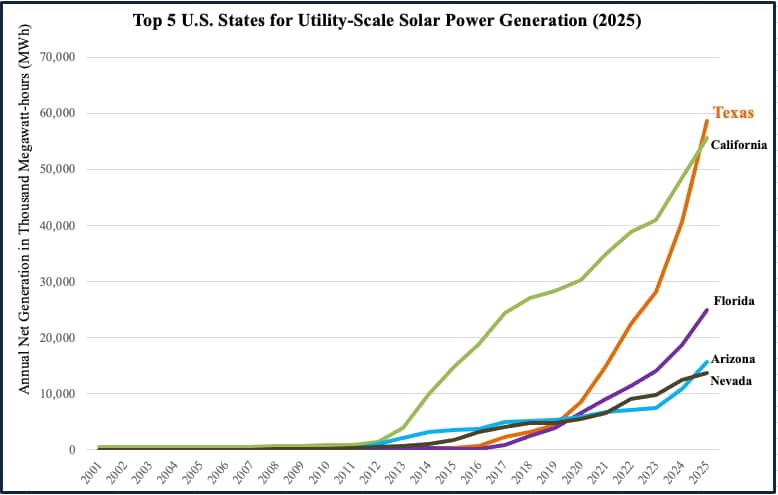
https://texas2036.org/news-analysis/growth-of-utility-scale-...
tl;dr: https://mlu3fafnp1cd.i.optimole.com/w:778/h:495/q:mauto/f:be...
[–] khalic 3 days ago
[–] hibikir 3 days ago
So even if a place like the US goes lighter on solar that is reasonable, Places like Spain, Italy or Morocco will go all in just to minimize dependence on a resource a third party can control. It's the ultimate counter to the Hormuz situation. Squeeze access to oil for long enough, and you accelerate the move away from it.
[–] alexk307 3 days ago
The U.S. solar industry installed 43 gigawatts (GW) of new capacity in 2025, remaining the dominant source of new capacity added to the grid for the fifth consecutive year. Solar and energy storage represent 79% of new capacity installed in the first year of the Trump Administration [2].
[1] https://www.chooseenergy.com/solar-energy/solar-energy-produ...
[2] https://tedmag.com/report-u-s-added-43-gw-of-new-solar-capac...
[–] knowaveragejoe 3 days ago
[–] dalyons 3 days ago
[–] bardak 3 days ago
[–] PyWoody 3 days ago
[–] triceratops 3 days ago
[–] xnx 3 days ago
[–] triceratops 3 days ago
[–] cheevly 3 days ago
[–] arbitrary_name 2 days ago
[–] bergie 3 days ago
[–] cogman10 3 days ago
For the right to actually embrace solar, you need either big money in solar to start it's own propaganda campaigns or you need big oil to collapse to the point where they can't afford paying propagandists. Right now, they are making record profits so don't count on that anytime soon.
[–] throwaway030 3 days ago
[–] EcommerceFlow 2 days ago
[–] linuxftw 3 days ago
[–] ks2048 3 days ago
Maybe the voters don't, but the businessmen and politicians definitely do, maybe more so than democrats. Just in different sectors (military).
[–] crote 3 days ago
Obvious counterpoints: Trump's $700m "clean, beautiful coal" handouts, or Trump's $2B buyback of wind farm leases.
[–] linuxftw 3 days ago
[–] triceratops 3 days ago
[–] bluGill 3 days ago
[–] dpkirchner 3 days ago
[–] linuxftw 2 days ago
[–] bluGill 2 days ago
[–] basch 3 days ago
[–] JuniperMesos 3 days ago
[–] basch 3 days ago
>Private industry should be able to profit off the sun and it's disturbing that you think asserting this is a dunk.
It wasn't a "dunk", you added that interpretation yourself.
[–] carlosjobim 3 days ago
[–] PaulDavisThe1st 3 days ago
A bit of realism would help here. Yes, there's a left/NIMBY overlap to some degree, but the forces from the non-right camp seeking to limit power development comes from the NIMBY elements, not the left elements.
[–] carlosjobim 3 days ago
Germany recently finished their complete dismantlement of the nations nuclear power. Another nuclear country Sweden, has shut down seven of their reactors, but are at least rhetorically changing back to supporting nuclear.
Go and talk in real life with people on the left and you'll find many of them are against nuclear power. Go and talk in real life with people on the right and it will be hard for you to find anybody who is against solar power. Because why would you be against solar?
[–] newyankee 3 days ago
[–] bagacrap 3 days ago
1. Then you need small scale transformers 2. Lots of roofs have shadows on them a lot of the time, like from trees or other nearby buildings 3. Most roofs have to get replaced every 15 years 4. Roof installed solar is fixed in place
I think parking lots, rural empty land and the like are a better starting point that avoids all 4 of these issues.
I have solar on my roof btw.
[–] viktorcode 3 days ago
[–] bagacrap 2 days ago
[–] adrianN 3 days ago
I'm surprised to hear that you need to replace roofs every fifteen years. What are they made of? The roofs I know last decades longer than that.
[–] bagacrap 2 days ago
And rooftop solar had to be subsidized in the US, so apparently it wasn't attractive enough as an investment on its own. Even now, solar without batteries isn't economically beneficial to individuals, and batteries are ludicrously expensive and require a lot of space.
> I'm surprised to hear that you need to replace roofs every fifteen years.
Asphalt shingles. Of course you can use something else like a metal roof. But the solar panel itself doesn't last that long since efficiency drops and new technology gets so much better. So you're still gonna have a new part of your house that can break whenever it feels like it and needs maintenance every so often. Something I want the government or a utility company to deal with, please.
[–] Mashimo 3 days ago
What in the world?? What are your roofs made out of?
[–] gniv 2 days ago
[–] Schiendelman 3 days ago
[–] fishfasell 3 days ago
[–] rib3ye 3 days ago
In red state language, conservation is being in tune with nature and environmentalism is regulatory capture.